Short answer: if you want a dining table you never think about, buy sintered stone. If you love the look of marble and you’re realistic about the upkeep, marble. Ceramic is fine, but nine times out of ten it’s sintered stone’s cheaper cousin with one or two compromises — usually thinner slabs and, on some tables, visible seams.
Full disclosure — we sell sintered stone. Take that context on board before the rest, but the honest breakdown of the three materials is below, including the bits the marketing usually skips and the situations where sintered stone isn’t the right answer.
Most guides on this topic are written to move you toward whatever the writer stocks. The problem with that is dining tables get used every day for a decade or more, and choosing the wrong material shows up quickly — in stained tops, in trivets you now have to hunt down before every roast, in that quiet resentment you feel wiping down the same coaster ring for the fiftieth time. This piece walks through what each material actually does under real-world use. Skip to the comparison table if you’re in a hurry.
What sintered stone actually is
Sintered stone was invented in the mid-2000s by a handful of Spanish and Italian manufacturers looking for a way to replicate natural stone without inheriting its weaknesses. The name comes from the process: sintering means bonding a material by heat and pressure without fully melting it. In a sintered stone slab, natural minerals — quartz, feldspar, silica, and small amounts of clay — are pressed under around 25,000 tonnes of force, then fired at about 1,200°C. The particles fuse into a single dense slab. No resin. No glue. No sealant.
That “no resin” bit matters more than it sounds. Quartz worktops, which look similar, are typically 90% mineral and 10% polymer resin — the resin is what makes them yellow slightly in direct sunlight, and it’s the reason a hot pan straight off the hob can leave a mark. Sintered stone has none of that. It’s 100% mineral. It doesn’t yellow, doesn’t off-gas, and it can take a pan pulled straight from a 300°C oven without a whisper of damage.
The hardness is roughly Mohs 8 to 9. For reference, a diamond is 10 and hardened steel is around 7. In practice this means the only thing in a normal kitchen that will scratch a sintered stone top is another piece of sintered stone or a diamond ring dragged edge-on with real force. Knives, keys, ceramic mugs — nothing. It’s also non-porous to a lab-tested level, which is why it doesn’t need sealing. Ever. Wipe with a cloth. That’s the whole maintenance routine.
The trade-offs are real, though. Sintered stone is heavy — a 20mm slab weighs about 50kg per m², which is why our two-person delivery is included on every stone table. It can chip if you drop a cast iron pan directly onto a corner or edge, and repairs are cosmetic patches rather than seamless fixes. And it’s cold to the touch, which some people love and some people don’t.
What ceramic actually is
Ceramic dining tops are essentially high-fired porcelain — the same material family as bathroom tiles, but engineered thicker (usually 10–12mm) and manufactured to more consistent tolerances. It’s a genuinely good material. Non-porous, heat-resistant to around 200°C, scratch-resistant, and often 20 to 35% cheaper than a comparable sintered stone table.
The catches are practical rather than dramatic. First, thickness: ceramic tops are thinner than sintered stone, so the “chunky slab” aesthetic you get from a 20mm sintered edge is harder to hit — some ceramic tables use a stepped mitre edge to fake the thickness, which looks fine but can chip more easily where the mitre meets. Second, and this is the one that catches people out: cheaper ceramic tables are sometimes assembled from tiles rather than cut from a single slab. The seams are usually well hidden but they exist. If you’re comparing two tables and one is £400 cheaper, look at the top from a low angle in raking light — you’ll spot the joins if they’re there.
Ceramic is the right answer when you want a modern, low-maintenance look and the budget won’t stretch to sintered. On a 160cm table you’re typically looking at £400 to £900 for ceramic versus £500 to £1,400 for sintered stone in the same size.
What marble actually is
Marble is a metamorphic rock — limestone that’s been buried, compressed, and reheated over millions of years until the calcite crystals fuse into the veined patterns we recognise. Every slab is unique. That’s the appeal, and it’s a real one. A well-quarried marble top is the only material on this list that gets more beautiful with age, in the way that leather does — small marks patina in, the veining deepens under light wear, and the whole surface takes on a lived-in quality that no engineered material can imitate.
The catch is that marble is porous. Calcite reacts with acid. Which means red wine, lemon juice, tomato sauce, and vinaigrette will all stain a marble top if left on the surface long enough, and by “long enough” we mean minutes, not hours. Sealed marble is much better protected — a fresh seal handles most spills for up to 24 hours — but sealant wears off with cleaning and use, and needs reapplying every 6 to 12 months to stay effective. Realistically, most marble owners we’ve spoken to do it once, forget, and live with a slowly accumulating map of stains that they eventually come to think of as character.
If that sounds like your kind of relationship with a table, marble is glorious. If you’d feel your heart drop the first time your six-year-old tips a glass of Ribena across it, sintered stone is the honest answer.
Solid wood, briefly
We don’t stock wooden dining tables at Aurino, but the material comes up in every conversation about materials so it’s worth including. Wood is the only surface here that improves with age if you’re willing to look after it — annual re-oiling, coasters under cold glasses to prevent white rings, and a general acceptance that marks are part of the deal. Oak, walnut, and ash all age beautifully. On a 160cm table, expect £350 to £2,500 depending on the species and construction (solid vs veneered).
Side-by-side — the honest comparison
| Property | Sintered stone | Ceramic | Marble | Solid wood |
|---|---|---|---|---|
| Heat resistance | To ~300°C, no trivet needed | To ~200°C | Handles heat, but seal-dependent | Trivets essential |
| Stain resistance | Fully non-porous | Non-porous, wipes clean | Porous — stains without sealer | Seal or oil required |
| Scratch resistance | Mohs 8–9, effectively scratch-proof | Scratch-resistant | Scratches from harder objects | Patinas over time |
| Weight per m² | ~50kg (20mm slab) | ~30kg (12mm slab) | ~55kg (20mm slab) | ~25kg |
| Sealing needed | None, ever | None | Every 6–12 months | Re-oil annually |
| Seams / joins | Single slab | Sometimes tiled — check carefully | Single slab | Boards, glued |
| Feels cold to touch | Yes | Yes | Yes | No |
| Price (160cm table) | £400 to £1,500 | £300 to £900 | £900 to £3,500 | £350 to £2,500 |
| Best for | Everyday tables, families, hot food straight to table | Same use case as sintered, tighter budget | Statement dining rooms, formal households | People who like ageing surfaces |
What people actually ask us
Does red wine stain a sintered stone table?
No. We’ve left red wine on a Polar White sintered top overnight during photography shoots more than once and wiped it clean the next morning without a mark. Sintered stone is non-porous at a lab-tested level. The only thing that will leave a residue is dried-on stickiness from sugary drinks, which wipes off with warm water.
Can I put a hot pan straight onto it?
Yes. Sintered stone is rated to handle sustained temperatures up to about 300°C, which is hotter than any pan will come off a domestic hob. We wouldn’t leave a red-hot cast iron skillet sitting there for hours on end because thermal shock over long periods is a real thing, but a fresh roasting tray for the fifteen minutes between oven and plate is completely fine. No trivet needed.
Will it chip if I drop something heavy on the edge?
It can, yes — and honesty matters here. Sintered stone is very hard but not indestructible. A cast iron pan dropped edge-first onto the mitred corner of a table can chip it, in the same way that dropping a heavy pot on a stone floor can chip the tile. The middle of the slab is much tougher than the edge. Most people go years without a mark; the ones that do get chips almost always do it on the corners.
Does it feel cold to the touch, like marble?
Yes. All three materials — sintered, ceramic, and marble — feel cool to the touch because they’re dense and don’t retain heat from the room. Wood is the outlier that always feels warm. Some people love the cool-slab feel of stone; others find it a bit chilly for breakfast on a winter morning. A tablecloth or runner solves it if that matters to you.
Is a ceramic dining table the same as sintered stone?
Not quite. They’re related — both are fired at high temperatures and both are non-porous — but sintered stone uses higher pressures and temperatures during manufacture, resulting in a denser, harder, and typically thicker slab. In marketing terms the two are sometimes used interchangeably, which isn’t accurate. A ceramic table is a good product; a sintered stone table is a slightly better one, and priced accordingly.
Do I need to seal it or condition it?
No sealing, no conditioning, no polishing, no annual maintenance of any kind. Warm water and a soft cloth is the full care routine. For dried-on food, a pH-neutral spray cleaner is fine. Avoid strongly acidic bathroom cleaners and abrasive scourers — not because they’ll damage the surface immediately, but because there’s no reason to use them.
Which one is right for you
Families with young kids: sintered stone
This is the household we designed our stone tables around. Spills happen. Homework gets done at the table. Play-Doh happens. If your table has to survive a decade of childhood without you thinking about it, buy sintered stone and move on. Everything else in this category will show wear on that use case.
Couples who entertain regularly: sintered or marble
If you’re the “we host Christmas” household, both work. Sintered stone lets you put hot pans and platters straight onto the table without a warmer, which changes how you host. Marble looks incredible under candlelight and photographs beautifully. Pick sintered if you host casually and often, marble if the dining room is a room in its own right and hosting is a bit of an event.
Minimalist / statement-piece buyers: marble
If the dining table is the anchor of an otherwise pared-back room and you’ll live with it more like a piece of art than a piece of furniture, marble is the honest answer. It has a depth and singularity that engineered materials can’t match. Just budget for the sealer, and don’t buy a white Carrara if you drink red wine regularly.
Marble-lovers on a budget: ceramic marble-look
A ceramic top with a marble-veined printed finish is a legitimate way to get the aesthetic without the price tag or the porousness. The compromise is that up close, in raking light, you can usually tell it’s printed rather than natural. From a normal viewing distance across the room it looks convincing. If the alternative is a piece of laminate pretending to be marble, ceramic is a big step up.
The tables we actually recommend
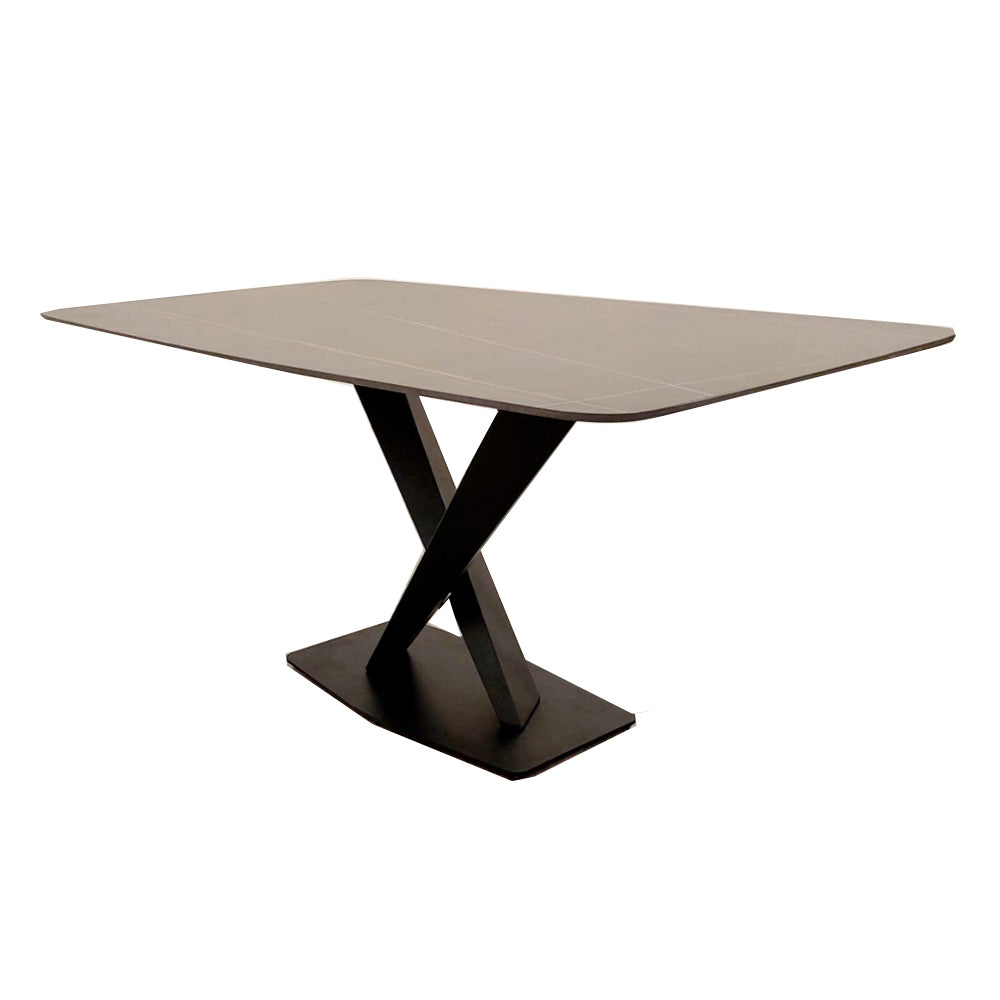
Apollo 1.6m Black Sintered Stone
Black sintered top, black powder-coated steel base. The most affordable way into real sintered stone at Aurino, and the one we’d recommend to a young family furnishing their first place.
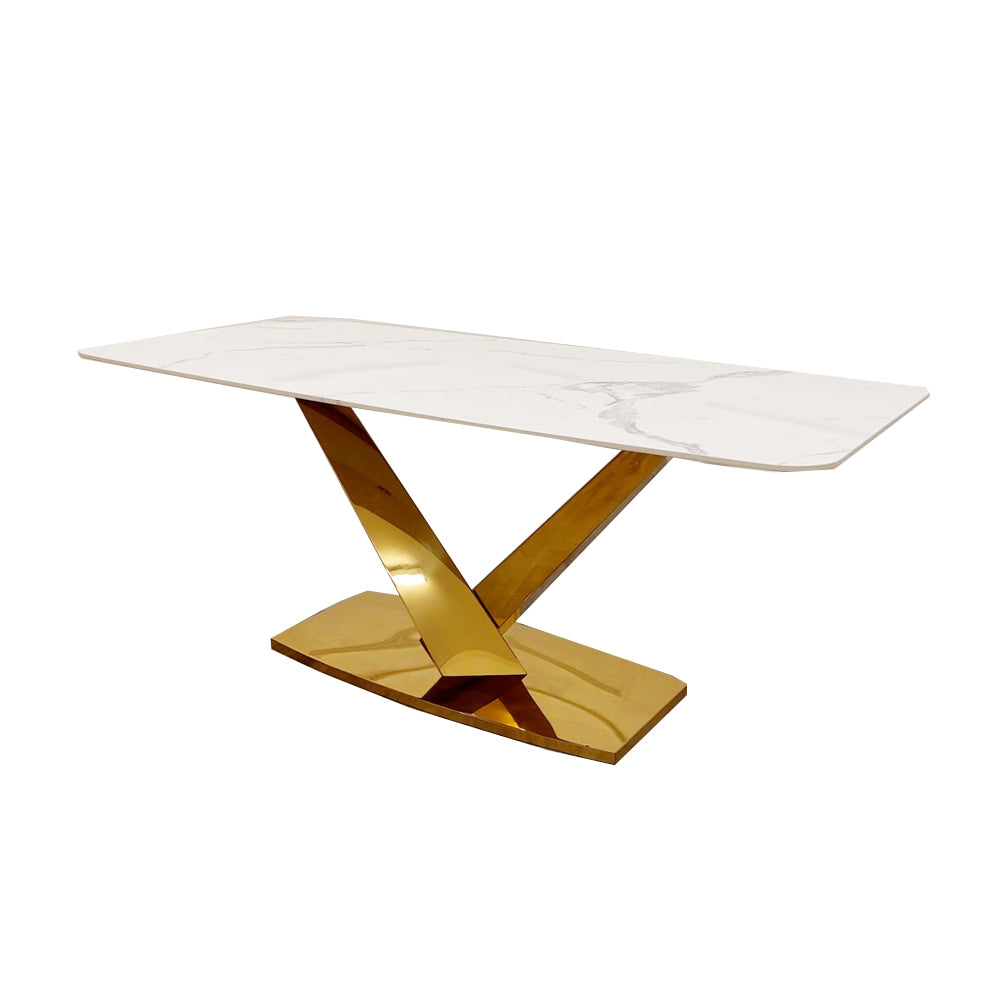
Valeo Gold 1.8m Polar White Sintered
Polar white sintered stone with brushed gold base. If you want the marble look with none of the marble headaches, this is the honest recommendation — bigger, showier, and the top will still be perfect in ten years.
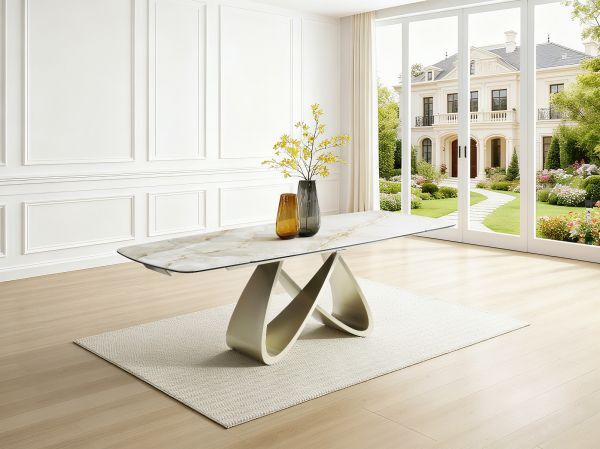
Ludovica Extending Dining Table
Six-seat sintered stone top with an extension leaf for when the numbers grow. The closest thing to “set and forget” we sell, and our personal favourite.
Or browse the full stone dining tables collection — every one has a sintered stone or ceramic top, 0% finance from £28/month, and two-person UK delivery included.